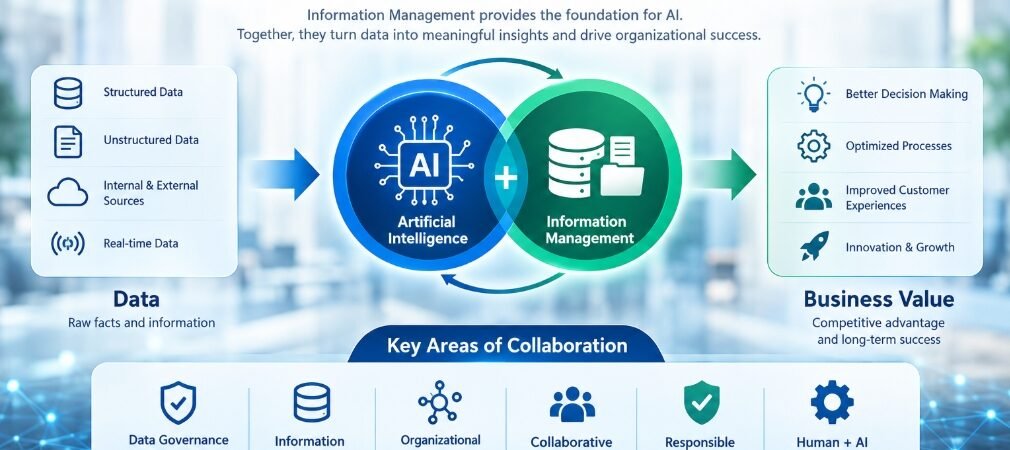
Artificial intelligence (AI) is rapidly transforming how organizations collect, manage, analyze, and use information. From customer segmentation and predictive analytics to automated service operations and AI-powered product development, organizations are increasingly integrating AI into core business functions. However, the effectiveness of AI does not depend on algorithms alone. High-quality information management (IM) is a fundamental prerequisite for building reliable, scalable, and strategically valuable AI systems.
According to McKinsey & Company (2022), organizations achieving the highest financial returns from AI have generally made greater investments in AI capabilities and have integrated AI more extensively into their business processes. This development highlights an important relationship between AI, data, information management, organizational decision-making, and business performance.
The Growing Importance of AI in Organizations
AI has moved beyond experimentation and is increasingly embedded in everyday organizational activities. Organizations are using AI for a broad range of applications, including:
- Optimization of service operations
- Customer segmentation and personalization
- Customer-service analytics
- Customer acquisition and lead generation
- Contact-centre automation
- Fraud detection and risk analysis
- Predictive maintenance
- Supply-chain optimization
- Product and service development
- Business forecasting and decision support
Major technology-driven organizations such as Google, Amazon, Tesla, IBM, Microsoft, Alibaba, DataRobot, Baidu, and Salesforce have invested heavily in AI and related technologies, including cloud computing, machine learning (ML), and predictive analytics.
The strategic objective is not simply to automate existing activities. Rather, organizations increasingly seek to use AI to augment human capabilities, improve decision-making, create new products and services, and respond more effectively to changing customer expectations.
Yet these objectives depend on something more fundamental: the availability of accurate, relevant, accessible, and well-governed information.
Information Management as the Foundation of AI
Information can be regarded as the lifeblood of an organization because virtually every organizational activity depends on the creation, exchange, interpretation, and application of information.
Cox (2014) emphasizes the significance of information within organizational processes, structures, and cultures. Organizations can be understood as social entities in which people, processes, technologies, and information interact to achieve particular objectives.
This perspective is particularly important in the context of AI. An AI system cannot independently determine what information is relevant, whether a dataset accurately represents organizational reality, or whether a particular piece of information should be trusted. These issues require appropriate information-management practices and organizational governance.
Effective IM typically encompasses activities such as:
- Information collection – acquiring data from internal and external sources.
- Data processing – cleaning, transforming, and preparing data for analysis.
- Information storage – maintaining information in secure and accessible systems.
- Information organization – establishing structures, taxonomies, metadata, and relationships.
- Information governance – defining policies concerning quality, access, ownership, security, privacy, and compliance.
- Information dissemination – ensuring that relevant information reaches appropriate users.
- Information retention and disposal – determining how long information should be retained and when it should be securely deleted.
These activities create the information environment in which AI systems operate.
AI and Information Quality
One of the most important relationships between AI and IM concerns information quality.
AI models learn patterns from data. If the underlying data are incomplete, inconsistent, outdated, biased, duplicated, or inaccurate, the resulting AI outputs may also be unreliable. Consequently, organizations cannot simply acquire large volumes of data and assume that this will automatically produce valuable AI applications.
The principle of “garbage in, garbage out” remains highly relevant in the age of AI.
Information management therefore contributes to AI by establishing processes for data quality assessment, data cleansing, metadata management, master-data management, and information governance. These practices can improve the reliability and usability of datasets before they are supplied to machine-learning or other AI systems.
The issue has become even more important with the rapid adoption of generative AI. Organizations now need to consider not only structured corporate databases but also documents, emails, knowledge repositories, customer interactions, websites, and other unstructured information.
AI as an Enhancer of Human Intelligence
AI should not necessarily be viewed as a replacement for human intelligence. Duan, Edwards, and Dwivedi (2019) argue that AI can contribute to the enhancement or augmentation of human intelligence and organizational decision-making.
This distinction is particularly important for information management.
Humans remain responsible for interpreting organizational objectives, defining business problems, establishing ethical boundaries, and determining how AI-generated information should be used. AI can process enormous quantities of information and identify patterns at a speed that would be difficult for individuals to achieve manually.
For example, an AI system may identify emerging customer trends from millions of interactions. However, managers still need to determine what those trends mean for the organization and what actions should follow.
Consequently, the relationship can be conceptualized as:
Information Management → Quality Information → AI Analysis → Human Interpretation → Organizational Decision-Making
This demonstrates why AI implementation cannot be treated solely as a technical project.
Organizational Structure and AI Adoption
Information management is also closely connected to organizational structure. Cox (2014) highlights the transition from traditional hierarchical structures toward more flexible and matrix-based organizational arrangements. Such structures can facilitate collaboration across functional boundaries, which is particularly valuable for AI initiatives.
AI projects frequently require collaboration among:
- IT specialists
- Data scientists
- Information managers
- Business managers
- Marketing professionals
- Legal and compliance teams
- Cybersecurity specialists
- Domain experts
- Senior leadership
A highly fragmented organizational structure can make it difficult to share data and knowledge across departments. In contrast, cross-functional structures can encourage information sharing and collaborative problem-solving.
Therefore, successful AI adoption requires organizations to consider not only what technology they deploy, but also how information flows across organizational boundaries.
Organizational Culture and the Meaning of Information
Organizational culture represents another critical dimension of AI and information management.
Cox (2014) argues that organizational culture develops through the shared history and experiences of an organization. Culture provides a context within which information receives meaning and data are interpreted.
This has significant implications for AI.
Two organizations may possess similar technologies and comparable quantities of data but obtain very different outcomes because their organizational cultures differ. An organization that encourages experimentation, evidence-based decision-making, knowledge sharing, and responsible technology adoption may be more capable of integrating AI into business processes.
Conversely, a culture characterized by information silos, resistance to technological change, limited collaboration, or distrust of automated systems can constrain AI adoption.
This suggests that AI transformation is simultaneously a technological and organizational transformation.
Data Governance, Privacy and Responsible AI
As organizations increasingly depend on AI, information management also becomes important from a governance and ethical perspective.
AI systems can process sensitive customer, employee, financial, and operational information. Consequently, organizations must establish appropriate mechanisms for:
- Data privacy
- Information security
- Access control
- Data ownership
- Regulatory compliance
- Bias monitoring
- Model governance
- Transparency
- Accountability
- Responsible data use
Recent AI governance developments have reinforced the importance of these issues. The European Union’s AI Act, for example, establishes a risk-based regulatory framework for artificial intelligence, while organizations globally are developing governance frameworks to address AI risks and accountability.
This means that information management is no longer concerned merely with where information is stored. It increasingly encompasses questions concerning who can use information, for what purpose, how information is governed, and how AI decisions based on that information can be monitored.
Generative AI and the Next Stage of Information Management
The emergence of generative AI has further strengthened the relationship between AI and information management.
Large language models can generate text, summarize documents, answer questions, and support knowledge work. However, organizations increasingly need these systems to work with their own proprietary information.
This has contributed to the growth of approaches such as retrieval-augmented generation (RAG), in which AI systems retrieve relevant information from organizational knowledge bases before generating responses.
The effectiveness of such systems depends heavily on the quality of the underlying information architecture. Poorly structured documents, inconsistent metadata, outdated information, and inadequate access controls can reduce the usefulness and reliability of enterprise AI applications.
Thus, generative AI has created a new strategic imperative: organizations must manage their information not only for human employees and conventional analytics but also for AI agents and AI-assisted knowledge work.
Information Management as a Strategic Capability
The relationship between AI and information management can therefore be understood as mutually reinforcing.
AI increases the organization’s ability to process and interpret information, while effective information management provides the foundation that allows AI systems to operate reliably.
A mature organization increasingly needs to think about information as a strategic asset:
Data → Information → Knowledge → Intelligence → Decision → Business Value
At each stage, information management plays an important role. Data must be collected and structured before it can become useful information. Information must be interpreted in organizational context to generate knowledge. AI can then support the identification of patterns and insights, while human decision-makers apply organizational judgment to convert those insights into action.
Conclusion
The growing adoption of artificial intelligence has fundamentally changed the role of information management within modern organizations. AI provides organizations with powerful capabilities for automation, prediction, personalization, knowledge discovery, and decision support. However, these capabilities depend on the availability of high-quality, well-governed, accessible, and contextually meaningful information.
Information management should therefore not be viewed as a supporting administrative function separate from AI strategy. It represents an important organizational foundation for successful AI adoption.
The organizations most capable of extracting sustainable value from AI are likely to be those that integrate technology with effective data governance, information quality, organizational structures, collaborative cultures, and human decision-making. In this sense, the future of AI is not simply about developing more sophisticated algorithms. It is also about developing better ways to manage, govern, interpret, and use information.
As AI continues to evolve from predictive analytics and machine learning toward generative AI and autonomous AI agents, information management will become increasingly central to organizational competitiveness, innovation, and responsible decision-making.
Team Cite&Write
References
McKinsey & Company. (2022). The state of AI in 2022—and a half decade in review. McKinsey Global Survey. McKinsey & Company – The State of AI in 2022
Duan, Y., Edwards, J. S., & Dwivedi, Y. K. (2019). Artificial intelligence for decision making in the era of Big Data – evolution, challenges and research agenda. International Journal of Information Management, 48, 63–71. https://doi.org/10.1016/j.ijinfomgt.2019.01.021.
Crockett, E. (2023). 100 Top Artificial Intelligence (AI) Companies in 2023. Datamation – Top AI Companies
National Institute of Standards and Technology (NIST). (2023). Artificial Intelligence Risk Management Framework (AI RMF 1.0). NIST – AI Risk Management Framework
National Institute of Standards and Technology (NIST). (2024). Artificial Intelligence Risk Management Framework: Generative Artificial Intelligence Profile (NIST AI 600-1). NIST – Generative AI Risk Management Resources
European Commission. (2024). AI Act enters into force. European Commission.