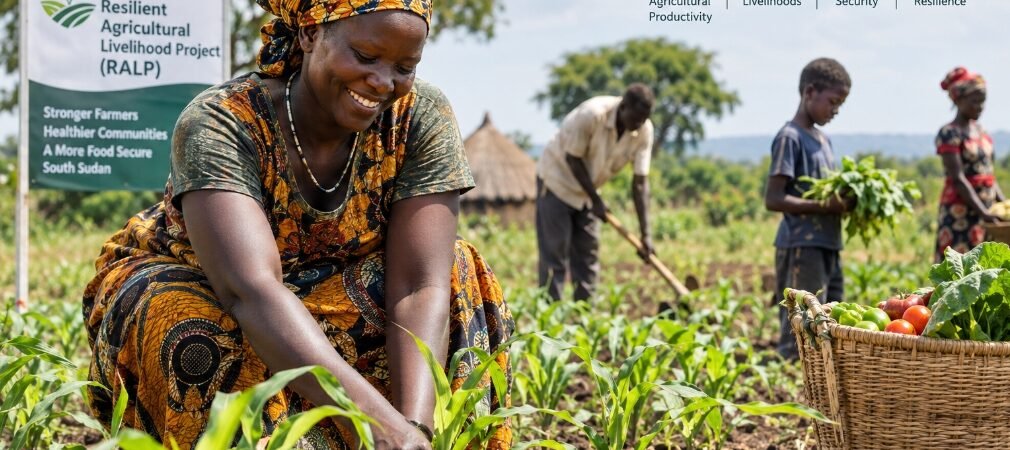
South Sudan faces a severe and multidimensional development crisis in which poverty, food insecurity, conflict, displacement, weak infrastructure and climate vulnerability reinforce one another. Despite its substantial agricultural potential, the country remains heavily dependent on humanitarian assistance, while a large share of its population struggles to secure adequate food and sustainable livelihoods. Women and children are particularly vulnerable to the consequences of poverty and food insecurity, including malnutrition, limited access to essential services and reduced livelihood opportunities.
Agriculture is central to addressing these challenges. Yet the sector remains fragile and constrained by low investment, inadequate infrastructure, limited access to agricultural inputs and markets, recurrent conflict, displacement, unpredictable rainfall and weak institutional capacity. In this context, initiatives such as the Resilient Agricultural Livelihood Project (RALP) represent an important shift from short-term humanitarian responses toward strengthening the productive capacity and resilience of rural communities.
A Deepening Poverty and Food-Security Crisis
South Sudan has one of the highest poverty rates in the world. More than 76 percent of the population is estimated to live below the national poverty line, while approximately two-thirds of the population experience extreme poverty. Poverty is particularly severe in rural areas, where households often depend directly on agriculture, livestock and natural resources for their survival.
Food insecurity is closely connected to this widespread poverty. Low household incomes restrict people’s ability to purchase food, while limited agricultural productivity reduces the availability of food produced locally. Rising food prices and inflation further erode household purchasing power. For families already living close to subsistence, even relatively small increases in the prices of staple foods, seeds, fuel or agricultural equipment can have serious consequences.
Women and children bear a disproportionate share of these hardships. Food insecurity can result in households reducing the quantity and quality of food consumed, with children facing heightened risks of malnutrition. Women, meanwhile, frequently carry substantial responsibility for household food security while having more limited access to productive resources, finance, land, agricultural extension services and markets.
Consequently, addressing food insecurity in South Sudan requires more than emergency food assistance. It requires strengthening the capacity of households to produce food, generate income and withstand economic, climatic and conflict-related shocks.
Agriculture at the Centre of the Development Challenge
Agriculture has enormous potential to contribute to poverty reduction and food security in South Sudan. A significant proportion of the population depends on farming and livestock for livelihoods. However, agricultural production remains well below its potential.
Several structural factors explain this gap. Agricultural investment remains limited, while farmers frequently have inadequate access to improved seeds, tools, fertilizers, extension services and agricultural knowledge. Poor roads and transportation networks make it difficult for farmers to transport crops to markets. High transportation costs can reduce the income farmers receive from their produce while simultaneously increasing food prices for consumers.
Climate variability adds another layer of uncertainty. Erratic rainfall, flooding and periods of drought can disrupt planting and harvesting cycles. For smallholder farmers with limited savings and few opportunities to access formal insurance or credit, a single failed season can push a household deeper into poverty.
Conflict and displacement compound these problems. Farmers may be unable to cultivate their land because of insecurity or displacement. Communities can lose livestock, agricultural equipment and seed stocks, while agricultural markets and supply chains may be disrupted. In areas affected by prolonged conflict, agricultural knowledge and productive assets can also deteriorate over time.
Past agricultural initiatives have therefore encountered significant difficulties. Widespread displacement, weak governance, inadequate planning, unpredictable weather and limited institutional capacity have constrained the sustainability and impact of agricultural development interventions.
From Humanitarian Assistance to Resilient Livelihoods
South Sudan’s dependence on international humanitarian assistance reflects the scale of its needs, but it also highlights the vulnerability of communities to changes in international funding. Humanitarian assistance remains essential during emergencies, particularly when households face acute food shortages. However, humanitarian assistance alone cannot create the long-term productive capacity required to reduce poverty.
A more sustainable approach combines immediate humanitarian support with investments that enable communities to produce food, generate income and respond to future shocks.
This is where resilient agricultural livelihood programs become particularly important. Rather than focusing exclusively on the distribution of food, such interventions seek to strengthen the underlying livelihood systems on which rural households depend.
The Resilient Agricultural Livelihood Project (RALP) reflects this approach. The project focuses on strengthening agricultural productivity and improving the capacity of communities to cope with economic, climatic and environmental pressures. Among its priorities is increasing access to climate-smart agricultural inputs, including improved seeds and other agricultural resources.
Crops such as maize, groundnuts, sorghum, cowpeas and vegetables have an important role in this strategy. Improving access to appropriate planting materials can help farmers increase productivity while diversifying the crops available for household consumption and income generation.
Climate-Smart Agriculture as a Pathway to Resilience
Climate-smart agriculture is particularly relevant in South Sudan because agricultural production is highly exposed to climate variability.
The objective is not simply to increase production under favourable conditions. Farmers also need agricultural practices and inputs that can help them maintain production when rainfall patterns change, temperatures rise or extreme weather events occur.
Climate-resilient seeds can contribute to this objective, particularly when they are appropriately matched to local growing conditions. However, seeds alone cannot solve the structural problems confronting South Sudanese farmers. Their effectiveness depends on complementary investments in extension services, soil management, water management, storage facilities, transportation and market access.
This suggests that agricultural resilience should be understood as a system rather than a single intervention. A farmer who receives improved seeds but cannot access markets, agricultural advice or reliable roads may still struggle to translate higher production into higher household income.
Infrastructure and Market Access
One of the most important barriers to agricultural development is inadequate infrastructure.
Poor roads create a physical divide between agricultural communities and markets. During periods of heavy rainfall, already weak transportation networks can become even more difficult to use. Farmers may be forced to sell crops locally at low prices because transporting produce to larger markets is too expensive or unreliable.
At the same time, poor infrastructure can increase the cost of agricultural inputs. Seeds, tools and other inputs may become more expensive when transportation costs are high. This creates a cycle in which farmers face high input costs and low farm-gate prices.
Investment in rural roads, storage facilities, local markets and transportation systems can therefore have benefits extending well beyond agriculture. Better connectivity can facilitate the movement of food, strengthen local trade, improve access to services and increase economic opportunities for rural communities.
Governance and Institutional Capacity
Agricultural development also depends on the institutional environment in which projects operate. Weak governance and limited administrative capacity can make it difficult to coordinate development programs, maintain infrastructure, distribute inputs effectively and monitor results.
For internationally funded projects, this presents a particular challenge. Financial resources and technical expertise may be available, but implementation can be undermined when local institutions lack the capacity to sustain interventions after external funding ends.
For this reason, strengthening local institutions should be considered an integral component of agricultural resilience. Community organizations, farmer groups, local authorities and agricultural extension systems can help ensure that investments remain useful beyond the life of individual projects.
Local ownership is equally important. Agricultural interventions are more likely to be sustainable when communities participate in identifying priorities, selecting appropriate crops and technologies, managing resources and evaluating outcomes.
Women and Youth: An Untapped Agricultural Resource
The agricultural transformation of South Sudan cannot be separated from the role of women and young people.
Women contribute substantially to food production, household nutrition and rural economies, yet they frequently face barriers to land ownership, finance, inputs, training and markets. Expanding women’s access to agricultural resources can therefore have effects that extend beyond individual farmers to household food security and child nutrition.
Young people are equally important. South Sudan has a young population, but limited employment opportunities can contribute to economic insecurity and social vulnerability. Agriculture and related value chains could provide opportunities for youth in farming, food processing, transportation, storage, marketing and agricultural services.
A resilient agricultural strategy should therefore go beyond increasing crop yields. It should create productive rural economies in which women and young people can participate meaningfully and earn sustainable incomes.
RALP and the Broader Development Agenda
The importance of RALP lies not only in the agricultural inputs it provides but also in the broader development pathway it represents. Improving access to climate-smart seeds, knowledge and agricultural skills can help households move from dependence toward greater productive capacity.
Nevertheless, agricultural projects must operate within South Sudan’s broader political, economic and environmental realities. Conflict, displacement, inflation, weak infrastructure and climate shocks can undermine agricultural gains if they are not addressed simultaneously.
This means that the long-term success of agricultural development will depend on coordination between agricultural investment, infrastructure development, peacebuilding, social protection, nutrition interventions and institutional strengthening.
Agriculture cannot be isolated from the wider development system.
From Vulnerability to Resilience
South Sudan’s food-security crisis is not simply a consequence of insufficient food. It is the result of interacting vulnerabilities: poverty limits purchasing power; conflict disrupts production and markets; inadequate infrastructure raises transaction costs; climate variability threatens harvests; inflation reduces household purchasing power; and weak institutions make sustained development more difficult.
Breaking this cycle requires a transition from repeated crisis response toward resilience-building.
Projects such as RALP can contribute to this transition by improving farmers’ access to productive inputs, agricultural knowledge and climate-smart technologies. But their impact will be greatest when these interventions are combined with investments in roads, markets, storage, extension services, local institutions and opportunities for women and youth.
Conclusion
South Sudan’s agricultural crisis is simultaneously a poverty crisis, a food-security crisis, an infrastructure crisis and a resilience crisis. With more than three-quarters of the population living below the national poverty line and millions experiencing extreme poverty, strengthening rural livelihoods is essential to the country’s long-term development.
The country’s agricultural potential provides an important foundation for this transformation. Yet realizing that potential will require more than distributing agricultural inputs. Farmers need reliable access to land, seeds, knowledge, infrastructure, markets and financial opportunities, while communities require greater protection from conflict and climate-related shocks.
The Resilient Agricultural Livelihood Project provides an important framework for addressing some of these challenges. Its emphasis on climate-smart inputs, agricultural skills and improved productivity can help strengthen household resilience and contribute to food security. Its longer-term significance, however, will depend on whether agricultural gains can be sustained and connected to broader improvements in infrastructure, governance, markets and community institutions.
For South Sudan, the ultimate objective should be to move beyond a cycle in which communities repeatedly require emergency assistance after each crisis. Building resilient agricultural livelihoods offers a pathway toward a future in which rural households are better able to produce their own food, generate income, withstand shocks and contribute to a more stable and self-reliant economy.
References
Atem, 2025. Infrastructure Development and Economic Growth in South Sudan; https://carijournals.org/journals/IJPID/article/view/2543?srsltid=AfmBOoqgyVrpQCi_ki6VqEJPoNvYMoQNND1lBa4PGBAzd5nSfWtBFwlq
Amnesty International, 2024. Reprioritising Resources for the Future of South Sudan; https://www.amnesty.org/en/latest/education/2024/08/reprioritising-resources-for-the-future-of-south-sudan/
IITA, 2025. Empowering South Sudan farmers to unlock agricultural potential; https://www.iita.org/news-item/empowering-south-sudan-farmers-to-unlock-agricultural-potential/
United Nations News, 2025. Famine stalks two counties in South Sudan as fragile peace is threatened; https://www.un.org/sustainabledevelopment/blog/2025/06/famine-stalks-two-counties-in-south-sudan-as-fragile-peace-is-threatened/
World Bank, 2023. Human Capital Country Brief; South Sudan [online] https://thedocs.worldbank.org/en/doc/64e578cbeaa522631f08f0cafba8960e-0140062023/related/HCI-AM23-SSD.pdf
World Bank Group, 2023. Resilience Agricultural Projects Boost Livelihoods of Vulnerable Communities in South Sudan; https://www.worldbank.org/en/news/feature/2023/12/22/resilience-agricultural-projects-boost-livelihoods-afe-1223-in-south-sudan
World Bank Group, 2024. New Report Reveals that Poverty and Vulnerability Remain Endemic in South Sudan, Despite the Country’s Abundant Resources; https://www.worldbank.org/en/news/press-release/2024/12/10/new-report-reveals-that-poverty-and-vulnerability-remain-endemic-in-afe-south-sudan