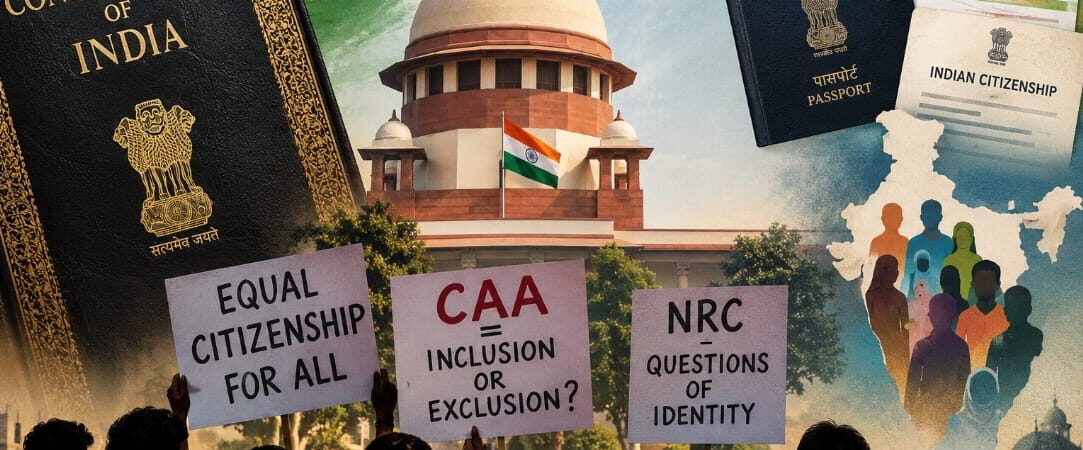
Citizenship Controversy: Who Belongs to India?
Citizenship is more than a legal relationship between an individual and the state. It defines who belongs to a political community, who can exercise particular rights, and who is recognised as a legitimate member of the nation. In a diverse democracy such as India, citizenship also raises fundamental questions about religious identity, constitutional equality, historical migration, and the meaning of national belonging. The citizenship controversy in India has become particularly prominent following the enactment of the Citizenship (Amendment) Act (CAA), 2019. By creating a specific pathway to citizenship for certain religious minorities from neighbouring countries, the legislation generated an intense debate about whether religious identity should influence access to Indian citizenship. The government has defended the legislation as a humanitarian measure, while critics have questioned its exclusions and compatibility with India’s constitutional commitment to secularism and equality. [1][2]
However, the controversy extends beyond the wording of a single law. It concerns a broader political dilemma: can a democratic state protect vulnerable populations while ensuring that the principles of equal citizenship remain universal?
1. Understanding Citizenship: Legal Status and Lived Experience
Traditionally, citizenship has been understood as formal membership of a sovereign state. It establishes a relationship involving rights, responsibilities, political participation, and legal recognition. The ability to vote, access certain public entitlements, and seek protection from state institutions illustrates the significance of citizenship.
Yet citizenship cannot be understood solely through legal documents. It also involves the everyday experience of belonging and the practical ability to exercise one’s rights.
Political sociologist T. H. Marshall distinguished between civil, political, and social dimensions of citizenship. Civil rights concern individual liberties and legal protection; political rights enable participation in public affairs; and social rights relate to access to welfare and the conditions necessary for a dignified life.
Building on this perspective, contemporary scholarship distinguishes between formal citizenship—legal recognition as a citizen—and substantive citizenship, which concerns the effective enjoyment of rights and participation in society.
This distinction is particularly important in India. A person may possess formal citizenship but encounter barriers to welfare, employment security, or political representation. Conversely, migrant workers may contribute substantially to the economy and urban society while experiencing difficulties accessing public services because they lack particular documents or cannot easily establish eligibility.
Anupama Roy’s study of citizenship regimes in India demonstrates how citizenship laws, administrative practices, and competing ideas of nationhood shape the boundaries of political membership. [3]
Thus, the citizenship debate must consider two connected questions: who is legally recognised as a citizen, and who can meaningfully exercise the rights associated with citizenship?
2. The Citizenship Amendment Act, 2019: What Does It Change?
The Citizenship Amendment Act, 2019, amended the Citizenship Act, 1955. It creates a special eligibility pathway for Hindus, Sikhs, Buddhists, Jains, Parsis, and Christians from Afghanistan, Bangladesh, and Pakistan who entered India on or before 31 December 2014 and meet the applicable statutory conditions.
The legislation addresses specified groups of migrants who entered India amid religious persecution or fear of such persecution. It also provides exemptions from certain provisions governing illegal migration and reduces the naturalisation residence requirement for eligible applicants. The implementing rules were notified on 11 March 2024, and the government began granting citizenship certificates under the rules in May 2024. [1][4]
The government’s position is that the law offers relief to vulnerable religious minorities from three neighbouring countries with Muslim-majority populations. It has also maintained that the legislation does not remove existing pathways through which other foreign nationals may apply for Indian citizenship.
Nevertheless, the Act has generated controversy because its eligibility framework expressly identifies six religious communities while excluding Muslims and does not cover persecuted groups from other neighbouring countries under this special pathway.
Critics argue that the use of religious identity as a criterion for preferential access to citizenship raises serious concerns about equality before the law and India’s secular constitutional framework. They also question why the framework does not extend to other persecuted populations, including some Muslim minorities and refugees from countries such as Myanmar and Sri Lanka. [2][5]
The disagreement, therefore, is not simply about whether persecuted people deserve protection. It is about how that protection should be defined, which groups should qualify, and whether religion is an appropriate basis for differentiating between applicants.
3. CAA and NRC: Why Are They Debated Together?
The National Register of Citizens (NRC) and the CAA are distinct legal and administrative frameworks, but they have frequently been discussed together in public debate.
An NRC is intended to identify people recognised as citizens through a registration and verification process. The CAA, by contrast, provides a special citizenship pathway for specified migrants who meet its conditions.
Concerns about their possible interaction became particularly significant during the nationwide protests of 2019–2020. Critics feared that, if a citizenship-verification process required people to establish their status through documentation, individuals unable to produce the necessary evidence could face uncertainty. They also argued that the CAA’s special pathway could treat similarly situated people differently on religious grounds.
The government has disputed claims that the CAA was designed to deprive Indian Muslims of citizenship and has described the legislation as a measure intended to help eligible minority migrants.
It is important, however, to distinguish between the law itself and concerns about how different policies might operate together. The CAA does not, by itself, automatically cancel the citizenship of Indian Muslims. Equally, the practical implications of citizenship-verification procedures depend on their legal design, implementation, evidentiary requirements, and safeguards.
The debate illustrates how public confidence in citizenship institutions depends not only on official assurances but also on transparent procedures and protection against arbitrary decisions.
4. Constitutional Equality and the Meaning of Secular Citizenship
India’s constitutional framework provides the central reference point for evaluating the citizenship controversy.
Articles 5–11 of the Constitution address citizenship at the commencement of the Constitution and Parliament’s authority to legislate on citizenship matters. Article 11 specifically preserves Parliament’s power to make laws concerning the acquisition and termination of citizenship and related questions. Article 14 guarantees equality before the law and equal protection of the laws to any person, rather than citizens alone. [6]
The central constitutional question is whether the distinctions introduced by the CAA can be justified within the framework of equality and constitutional secularism.
Supporters contend that the Act addresses a particular historical and regional problem: the vulnerability of specified religious minorities in neighbouring countries. From this perspective, a targeted humanitarian measure need not necessarily cover every form of persecution to have a legitimate purpose.
Critics counter that selecting beneficiaries through a religious classification raises concerns about unequal treatment. They argue that a secular citizenship regime should establish transparent, consistent criteria for addressing persecution and vulnerability without privileging some religious communities over others.
These arguments involve different understandings of constitutional equality. Equality does not necessarily prohibit every legislative distinction; the legal question includes whether a classification is constitutionally permissible. Nor does the government’s humanitarian rationale, by itself, settle questions about the constitutionality of the classification.
As of October 2026, the CAA’s constitutional validity remains a significant subject of legal contestation. The Supreme Court scheduled final hearings on challenges to the Act and its rules beginning on 5 May 2026. The precise status and outcome of those proceedings should be checked against the latest Supreme Court orders before publication. [7]
The distinction between political argument and judicial determination is crucial: criticism of a law is not itself a judicial finding of unconstitutionality, just as its enactment does not eliminate legitimate constitutional scrutiny.
5. Citizenship, Documentation, and the Marginalised
The citizenship controversy becomes more complex when viewed through the experiences of poor households, informal workers, and internal migrants.
Millions of people move within India in search of employment, education, and improved living conditions. Their movement does not, by itself, change their citizenship. Nevertheless, migration can disrupt access to documents, public distribution systems, welfare programmes, and administrative records.
The COVID-19 lockdowns exposed some of these vulnerabilities. Migrant workers experienced difficulties obtaining food, transport, income support, and other assistance, particularly when public services were tied to documentation, registration, or residence-related requirements.
These experiences reveal a crucial distinction: lack of access to a particular document or welfare entitlement is not the same as lack of citizenship.
Yet the distinction can become blurred in everyday interactions with public institutions. When access to essential services depends heavily on documentary proof, administrative exclusion can undermine the practical value of citizenship.
The lesson is not that citizenship verification should never occur. Rather, verification systems must be designed to minimise wrongful exclusion, allow people to correct errors, provide accessible appeals, and recognise the realities of poverty and mobility.
Citizenship should not become meaningful only for people who possess the resources and institutional access necessary to navigate complex administrative procedures.
6. Citizenship as a Political Struggle
Citizenship is not merely a status granted by the state. It is also shaped by social movements, public debate, legal challenges, and collective demands for recognition.
The protests against the CAA demonstrated how citizenship legislation can become a focal point for competing visions of the nation. Students, civil society groups, political organisations, and citizens from different religious backgrounds participated in demonstrations, although the movement included diverse constituencies and viewpoints.
For many opponents, the protests represented a defence of secular citizenship and constitutional equality. For supporters of the legislation, the Act represented recognition of the historical vulnerability of particular minorities in neighbouring countries.
These competing narratives illustrate the political character of citizenship. Citizens do not simply receive legal status passively; they also debate the meaning of membership and challenge the boundaries established by public institutions.
This perspective aligns with scholarship on the relationship between citizenship, political participation, and social struggle. It also suggests that the legitimacy of citizenship policies depends partly on whether affected communities can access meaningful avenues for democratic participation and legal redress.
At the same time, the existence of protest does not establish the legal merits of every claim made by protesters. Public mobilisation and constitutional adjudication are different, though interconnected, ways in which democratic societies contest the exercise of state power.
7. Beyond the CAA: A Wider Crisis of Belonging?
The citizenship controversy in India raises questions that extend beyond a single statute.
First, it challenges policymakers to consider how humanitarian protection can be extended to persecuted populations without creating unjustified distinctions.
Second, it highlights the importance of administrative fairness. Documentation and verification procedures should be transparent, proportionate, and accessible, especially for people facing poverty, displacement, or limited access to official records.
Third, it raises questions about the relationship between national identity and constitutional identity. A state may recognise historical experiences and regional security concerns, but it must also operate within the constitutional framework that governs its institutions.
Finally, the controversy demonstrates that citizenship is simultaneously a legal status, a political identity, and a lived experience. These dimensions may reinforce one another, but they can also come into tension.
A state may formally recognise an individual’s membership while that person experiences barriers to substantive rights. Conversely, a humanitarian policy may expand access to citizenship for certain groups while generating legitimate questions about the treatment of those outside its scope.
The challenge is to develop citizenship institutions that can address historical injustice without weakening the principle of equal protection.
Conclusion: Reclaiming the Meaning of Citizenship in India
The citizenship controversy in India is fundamentally a debate about the relationship between national sovereignty, humanitarian responsibility, religious identity, and constitutional democracy.
The CAA, 2019, reflects one approach to protecting specified religious minorities from neighbouring countries. Its supporters emphasise the humanitarian rationale behind its provisions, while its critics question the religious classification and the implications for secular equality. The relationship between the CAA, the NRC debate, and wider problems of documentation has intensified public concern about the boundaries of political membership.
A meaningful assessment must move beyond political slogans. It requires close attention to statutory provisions, constitutional principles, administrative implementation, judicial scrutiny, and the lived experiences of affected communities.
Ultimately, the strength of Indian citizenship should be measured not only by the state’s ability to define membership, but also by its capacity to administer the law fairly, protect constitutional rights, and ensure that people are not arbitrarily excluded from legal recognition or essential entitlements.
The enduring question is therefore not simply who belongs to India. It is how a constitutional democracy determines belonging while preserving the equality, dignity, and pluralism on which democratic legitimacy depends.
References
- Ministry of Home Affairs, Government of India. (2019). The Citizenship (Amendment) Act, 2019, and (2024), The Citizenship (Amendment) Rules, 2024. Official legislation and rules. https://www.mha.gov.in/en/divisionofmha/foreigners-division
- Reuters. (13 March 2024). CAA: Why is India’s citizenship law contentious? https://www.reuters.com/world/india/caa-why-is-indias-citizenship-law-contentious-2024-03-13/
- Roy, A. (2022). Citizenship Regimes, Law, and Belonging: The CAA and the NRC. Oxford University Press. https://doi.org/10.1093/oso/9780192859082.001.0001
- Press Information Bureau, Government of India. (15 May 2024). First set of citizenship certificates after notification of Citizenship (Amendment) Rules, 2024 issued. https://www.pib.gov.in/PressReleasePage.aspx?PRID=2020671
- Varghese, L., & Narasappa, H. (2019). “Contestations over Indian Citizenship: An analysis of the Citizenship (Amendment) Bill, 2016.” National Law School of India Review, 31(2), Article 3. https://repository.nls.ac.in/nlsir/vol31/iss2/3/
- Government of India. The Constitution of India, Part II, Articles 5–11, and Article 14. Legislative Department. https://www.legislative.gov.in/
- Supreme Court Observer. (19 February 2026). Citizenship Amendment Act: Supreme Court schedules final hearings in May 2026. https://www.scobserver.in/reports/citizenship-amendment-act-supreme-court-schedules-final-hearings-in-may-2026/
- Marshall, T. H. (1950). Citizenship and Social Class and Other Essays. Cambridge University Press.
- Isin, E. F., & Nyers, P. (Eds.). (2014). Routledge Handbook of Global Citizenship Studies. Routledge.
- Ong, A. (1999). Flexible Citizenship: The Cultural Logics of Transnationality. Duke University Press.